STEN SVEHN
THE LINE
BETWEEN LIES
London, 1973. A Soviet illegal operating under a New Zealand cover meets a British intelligence officer at a gallery opening and falls in love. She is then tasked with cultivating him—mapping him, handling him, and when the time comes, destroying him.
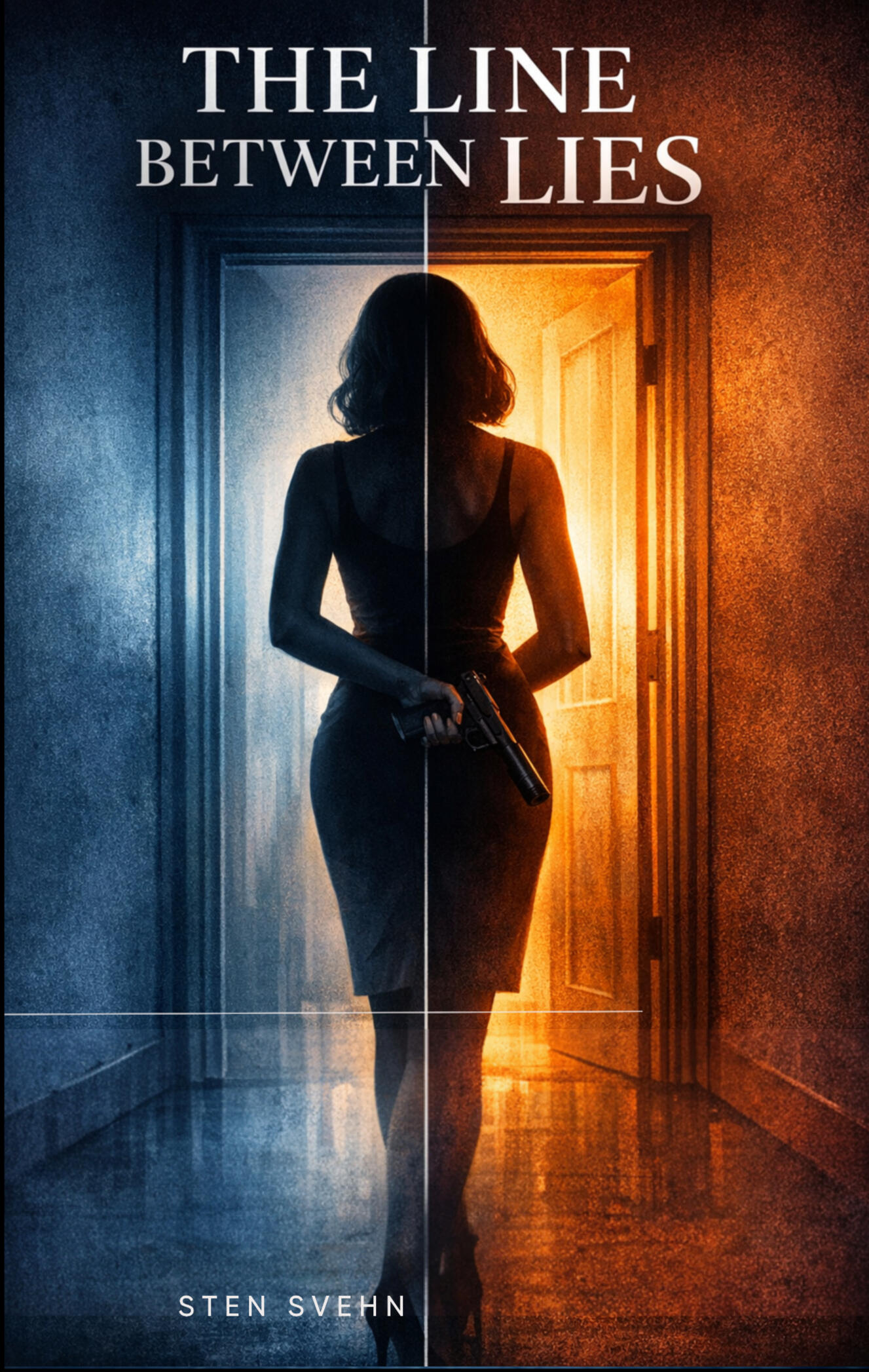
THE LINE BETWEEN LIES
Sten Svehn · HSJ Publishing · 2026Elena Vasilieva has been Alice Marsh for decades—a New Zealand art historian, a Kensington flat, a cover so complete it has its own grief. Her mission is James Calder, MI6. Cultivate him. Map his network. When the time comes, destroy him.A Nagra recorder in a kitchen drawer. A Soviet camera in a Ronson lighter. Dead drops on Hampstead Heath, a Stasi file, a forged passport used in Athens, a warhead that moved in the night. Sixteen years of secrets that cannot be reported and cannot be destroyed.When the Wall falls, nothing ends. Some things have only been waiting.A Cold War novel about intelligence, loyalty, and the things we do for love.
'The best lies were true. They always were.'
STEN SVEHN
Sten Svehn was born in Oslo and has lived and worked across Northern Europe, the United Kingdom, and the United States. He spent two decades in roles that required him to understand how institutions communicate, how information moves, and what makes it into the official record.His nonfiction book Survival Over Service examined the documented history of institutional self-preservation across the major intelligence agencies.The Line Between Lies is his first novel.
© 2026 Sten Svehn · HSJ Publishing · [email protected]
CHAPTER 1
The bartender had been watching her for an hour, long enough to know it wasn’t beauty that held his attention. He’d seen beauty before. The Finnish cellist from last November—all cheekbones and sorrow—had ordered three glasses of Riesling and left without paying. But this one had something the cellist hadn’t—a quality of attention. She tracked the room in small, economical glances. Once satisfied, she sat with the stillness of someone who knew exactly where her edges were.He found himself cataloging the young woman without meaning to.Her dark hair was cut just above her shoulders. She had a jawline out of a Soviet recruitment poster, softened by a mouth that seemed perpetually deciding between a smile and something more dangerous. She was drinking gin and tonic—her second. The gin was mediocre. Everything in Lillehammer was mediocre—the way small towns were mediocre, without pretension, as if mediocrity were a civic virtue.The next thing he noticed was the way she watched the door.
Not obviously. Not the way a woman waiting for a date watches a door, with hope, impatience and anxiety. This woman watched the door the way a chess player watches the board between moves, with patience, with the calm certainty that whatever came next was something she already planned for.
When she reached for her drink, her sleeve rode up and the bartender caught, for a half-second, a small mark on the inside of her left wrist—a compass rose, four directions, with a small inked dot at the center where the directions met. It was small enough to be hidden by a watch she wasn’t wearing tonight. The sleeve fell back, and the mark was gone.◆ ◆ ◆The bartender did not know about the other one.No one in this bar would ever see the other one.A line of Russian text along her ribcage, inked at nineteen by a dissident artist in a Leningrad apartment that no longer existed. He was arrested six months later. Elena never spoke his name again. The tattoo read: I taught myself to live simply and wisely. Anna Akhmatova. The poet who survived Stalin by outlasting him. It was the last true thing she put on her body.
Everything since—the accent, the passport, the name, the entire architecture of a life built on someone else’s biography—was construction.Her name tonight was Alice Marsh. It had been Alice Marsh for two years. It would be Alice Marsh for seventeen more.But tonight Elena was twenty-five years old. She was in Lillehammer, Norway. In fourteen minutes, a man named Ahmed Bouchiki would step into the wrong moment on the wrong street. Elena would watch. She would feel nothing and file everything. When it was done, she would kill someone else entirely.◆ ◆ ◆Elena arrived in Norway three days ago with the New Zealand passport. The good one. The passport was a work of art, though not because of the forgery. Soviet document fabrication was standardized and therefore excellent—the inks were sourced from the same chemical suppliers that legitimate governments used, the paper stock was identical, and the lamination process had been perfected by a laboratory in Minsk that also produced forged pharmaceutical certificates.The cover was not a mask she wore. It was a second skeleton grown inside her own body. One could not remove Alice Marsh from Elena Vasilieva without surgery. And Elena wasn’t sure, on the nights when she lay awake in hotel rooms that smelled like other people’s cigarettes, which skeleton would survive the operation.But that was not tonight’s problem.◆ ◆ ◆Tonight’s problem was in apartment 3B on Storgata, six blocks north. He was listening to the radio with a cup of tea, not yet aware that the last three years of his quiet Norwegian retirement were about to end...
© 2026 Sten Svehn · HSJ Publishing · [email protected]